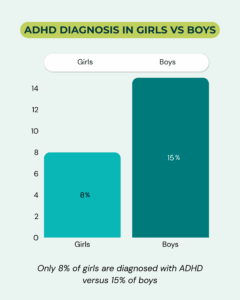
There has long been a distinct gap in the diagnosis of ADHD in boys versus girls. Boys (15%) are nearly twice as likely to be diagnosed with ADHD as girls (8%), though that gap shrinks as they move to adulthood. It has previously been thought that boys are more likely to have ADHD, but there is growing evidence that girls are simply diagnosed at a lower rate—a discrepancy which fades as women pursue diagnoses on their own later in adulthood.
 ADHD was initially studied only in elementary aged boys, giving a skewed representation of how it might present. So, it’s no surprise that plenty of girls have gone undiagnosed as a result. ADHD has classically been represented as a rambunctious disorder where kids bounce off the walls or are constantly shifting focus. While this can be a type of presentation, it is far from the full picture. Many children with ADHD internalize their symptoms and become shy, withdrawn, and anxious.
Girls in particular are often socialized to mask their problems and end up internalizing their ADHD more often, causing symptoms to present differently. Whereas a boy might blame a situation when struggling, girls are more likely to blame themselves, assigning their executive dysfunction or other ADHD characteristics to an internal character flaw.
Because of this internalization process, evidence shows that girls with ADHD are more likely to engage in self-harm behaviors in adulthood. Diagnosing girls earlier—even without prescribing medicine—could be protective, as children understand their struggles through the lens of ADHD rather than believing themselves to be ‘lazy’ or ‘bad’ in some way.
So, what does ADHD look like in girls? For one thing, Girls with ADHD are also more likely to present with inattentive symptoms and anxiety, features that are easily missed by teachers. Here is a collection of symptoms that describe ADHD in girls:
- Verbal hyperactivity, i.e. being called a ‘chatterbox’
- A tendency to daydream or seem lost in their own world
- Anxiety and depression
- A habit of abandoning plans or goals halfway through
- Avoiding people or tasks that can be demanding
- Picking at skin or cuticles
- Being a perfectionist
- Trouble maintaining friendships
Girls with ADHD are more likely to seem chatty, dreamy, or forgetful instead of actively disruptive.
Undiagnosed ADHD can take a toll on girls’ mental health, damaging their self-concept and often leading to anxiety and depression. Looking for the specific symptoms as they present in girls can help bridge the diagnosis gap. A diagnosis can also help girls understand their struggles without the stigma of it being their “fault,” allow access to necessary supports, and lead to more stable self-esteem and better well-being.
References